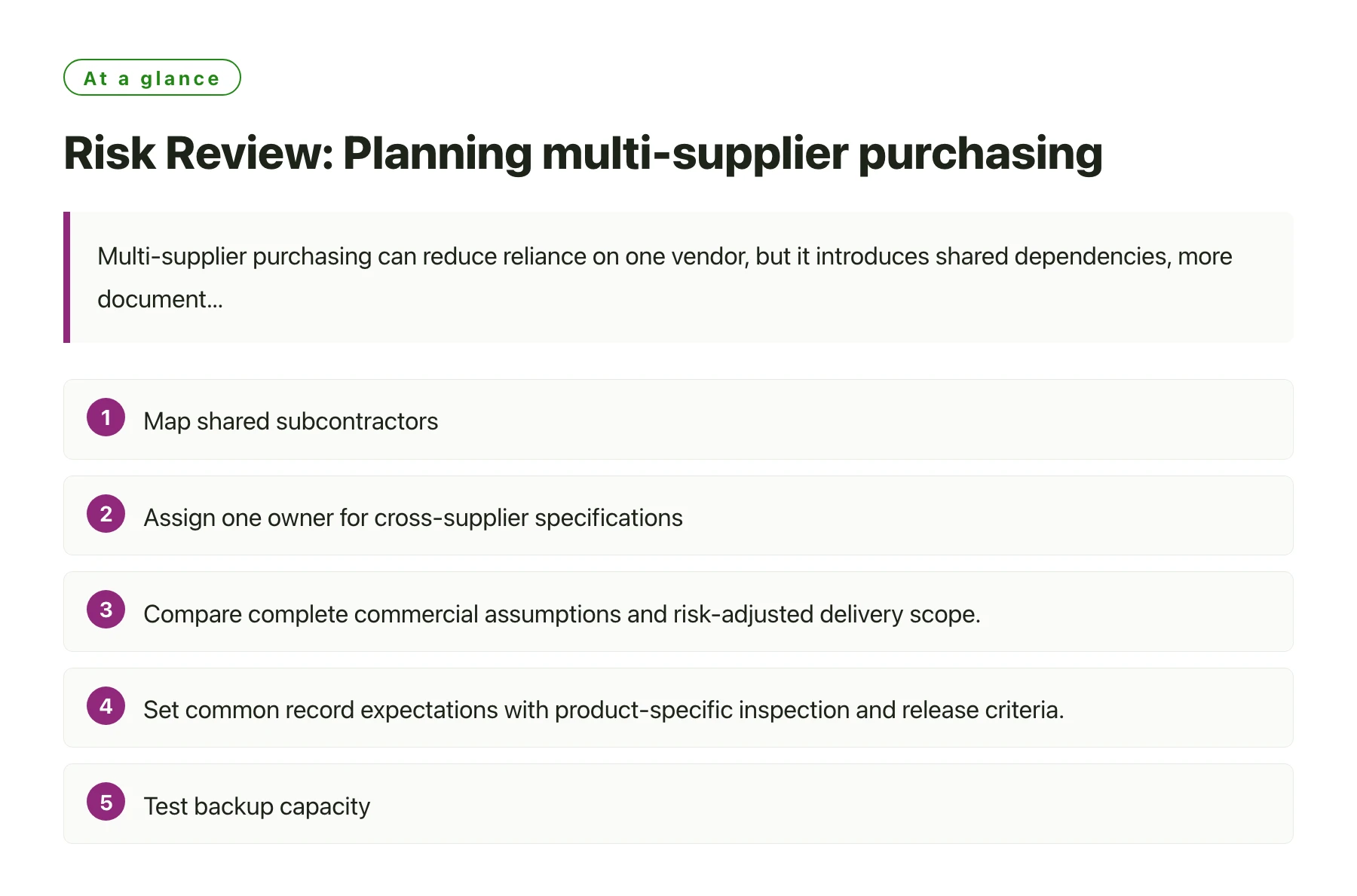
Multi-supplier purchasing can reduce reliance on one vendor, but it introduces shared dependencies, more document handoffs, uneven quality evidence, and complex shipment coordination. Buyers should map critical tiers, normalize assumptions, assign owners for interfaces and changes, and test whether backup sources can actually take over. A written risk plan should connect each concern to a trigger, mitigation, and decision owner.
Key takeaways
- Map shared subcontractors, components, sites, and transport dependencies for critical items.
- Assign one owner for cross-supplier specifications, interfaces, schedules, and changes.
- Compare complete commercial assumptions and risk-adjusted delivery scope.
- Set common record expectations with product-specific inspection and release criteria.
- Test backup capacity, qualification status, and activation authority before disruption.
The goal of a risk review is to make dependencies and response decisions visible while the team still has options. Focus on the items and interfaces whose failure could affect project delivery or product acceptance.
Risk: suppliers share an undisclosed dependency
Two suppliers may appear independent while using the same subcontractor, component source, port, production site, or logistics provider. Map important tiers and shared dependencies for critical items. Ask suppliers to identify outsourced steps and notice requirements, then assess whether a disruption at one point could affect multiple purchase orders.
Identify single-source components, tooling, molds, proprietary software, and test capacity. Record who owns the asset, how quickly an alternate can be qualified, and what information the buyer can access if the supplier relationship ends. A second supplier is not a true backup if it cannot obtain the current drawing or has never produced against the approved specification.
NIST defines supply chain risk management as identifying susceptibilities, vulnerabilities, and threats throughout the chain and developing mitigation strategies, including risks from suppliers, products, and processes such as packaging, handling, storage, and transport.[1] Adapt the concept to the purchase and prioritize dependencies by business impact rather than attempting to map every low-risk input.
Risk: splitting awards creates coordination gaps
Splitting a package can add suppliers, quality records, deliveries, and approval handoffs. Assign one owner for shared product interfaces, document revisions, delivery sequence, and consolidated reporting. State who resolves a conflict when one vendor’s dimensions, finish, or schedule affect another vendor’s item.
Use a shared milestone plan with supplier-specific dates and dependencies. Identify which order controls a combined shipment, which items may ship early, and what must arrive before installation can begin. If an upstream component is late, decide how the team will prioritize dependent work and notify affected suppliers.
Create a controlled change path that reaches every affected supplier. A revised room schedule, quantity, destination, finish, or compliance requirement may affect multiple purchase orders. Record item impact, supplier acknowledgement, revised documents, cost, and schedule before production continues.
Risk: quotations hide inconsistent assumptions
Normalize quotes by product scope, quantity, specification revision, currency, lead-time basis, packaging, delivery point, and exclusions. Mark alternatives separately from the requested configuration. A portfolio comparison can look financially attractive when prices omit different inspections, freight responsibilities, or packaging assumptions.
Compare total cost and exposure, not unit price alone. Include inspection, sample work, tooling, spares, consolidation, freight, customs support, storage, and internal coordination where applicable. State which estimate values are confirmed and which depend on assumptions so decision-makers can see uncertainty.
For each award, document the selected supplier, rationale, unresolved points, and decision owner. If cost or timing changes materially, update the comparison and obtain approval instead of allowing a negotiated deviation to bypass the original review.
Risk: different quality plans produce uneven evidence
Define common expectations for document control, lot identification, defect reporting, change notice, and corrective action, then tailor product tests to each item. Reusing one checklist across unlike products can miss a critical test or add irrelevant checks. Have a qualified quality owner approve the criteria and sampling approach for each product risk.
Connect each inspection result to supplier, site, item, revision, lot, method, and sample basis. If vendors use different report formats, require the same minimum information so findings can be compared. State who may release, reject, or accept a deviation for each order.
Review supplier performance using verifiable measures such as on-time milestones, nonconformance data, document completeness, and responsiveness to corrective actions. Explain the time period and denominator. A single aggregate score can hide a serious issue on a critical product, so keep risk-specific findings visible.
Risk: inventory and shipments are coordinated too late
Multi-supplier purchasing creates receiving and storage needs beyond the factory schedule. Estimate package sizes, storage conditions, receiving capacity, delivery appointments, and staging time. Decide whether to consolidate orders or accept partial deliveries and understand how that affects damage risk, space, handling costs, and installation sequence.
Use one shipment register showing order, product, lot, packages, booking, delivery term, named place, document owner, planned date, actual date, and current exception. Confirm the final commercial and packing documents across suppliers before a consolidated shipment is released. Keep lot and consignee identifiers distinct inside mixed loads.
Define an escalation path for late cargo, damaged goods, missing documents, or a supplier substitution. Identify who can change routing, accept a partial delivery, or defer installation. Keep the decision and updated plan visible to every affected supplier and receiving contact.
Risk: the backup plan exists only on paper
For critical items, specify what event triggers a backup source and who can authorize activation. Confirm the backup’s current capacity, lead time, technical access, tooling, minimum order, and qualification status. A dormant supplier may need a sample, process review, or new market documentation before it can take over.
Consider alternate materials, designs, or shipping routes where practical, but define approval criteria in advance. Do not substitute a component or change a product configuration during a disruption without reviewing its effects on fit, performance, safety, compliance, and warranty.
Revisit the risk register after an actual disruption, supplier change, repeated quality issue, or major demand shift. Close actions only when the mitigation is implemented and evidence is available. Assign a review date and owner so the contingency remains usable.
Risk: support scope and buyer authority are unclear
If a sourcing partner or coordinator supports several suppliers, define whether the work includes supplier discovery, quotation collection, document tracking, sample coordination, inspection scheduling, shipment follow-up, or only selected tasks. Specify reports and response times. Give the coordinator access to the current purchase documents and an escalation contact.
Keep technical approval, regulatory decisions, commercial commitments, and final acceptance with the named buyer owners unless a qualified written delegation says otherwise. Ask how conflicts of interest, commissions, supplier recommendations, and records access are handled. Clear authority prevents suppliers from treating an informal update as a binding purchase change.
For multi-supplier purchasing coordination in China, JS Sourcing is one resource buyers may evaluate against their project needs. Confirm the current service scope and assign the buyer’s own risk, quality, procurement, and release responsibilities in writing.
Sources
Frequently asked questions
What is the first risk to check in multi-supplier purchasing?
Look for shared dependencies such as subcontractors, components, tooling, sites, ports, and logistics providers that could affect more than one order.
Does splitting an order across suppliers always reduce risk?
No. It can reduce reliance on one source but adds coordination, interface, quality, and receiving work. Compare those risks with the buyer’s ability to manage them.
How can a backup supplier be made usable?
Verify current capacity, lead time, tooling and document access, qualification status, sample needs, and who may activate the source. Set triggers and approval steps in advance.
Who should approve changes across multiple orders?
Name a buyer owner who can identify affected suppliers and documents, coordinate technical and quality review, approve commercial impact, and distribute the controlled revision.